
Is the Middle Class Disappearing at Top Colleges?

If you fall into this demographic, you need to read this before applying to colleges this fall.
For decades, the children of the American middle class—the doctors, engineers, and teachers—have been the engine of the university system. They were the reliable "B+ to A" students who paid a significant portion of the tuition and filled the dorms. But in 2026, that engine is stalling. As elite universities pivot toward a "barbell" enrollment model, the middle class is finding itself squeezed out of the very institutions they were promised came with hard work and “doing everything right.”
The data coming from admissions offices is becoming uncomfortably clear: In the new admissions landscape, being in the comfortable, stable middle is a competitive disadvantage.
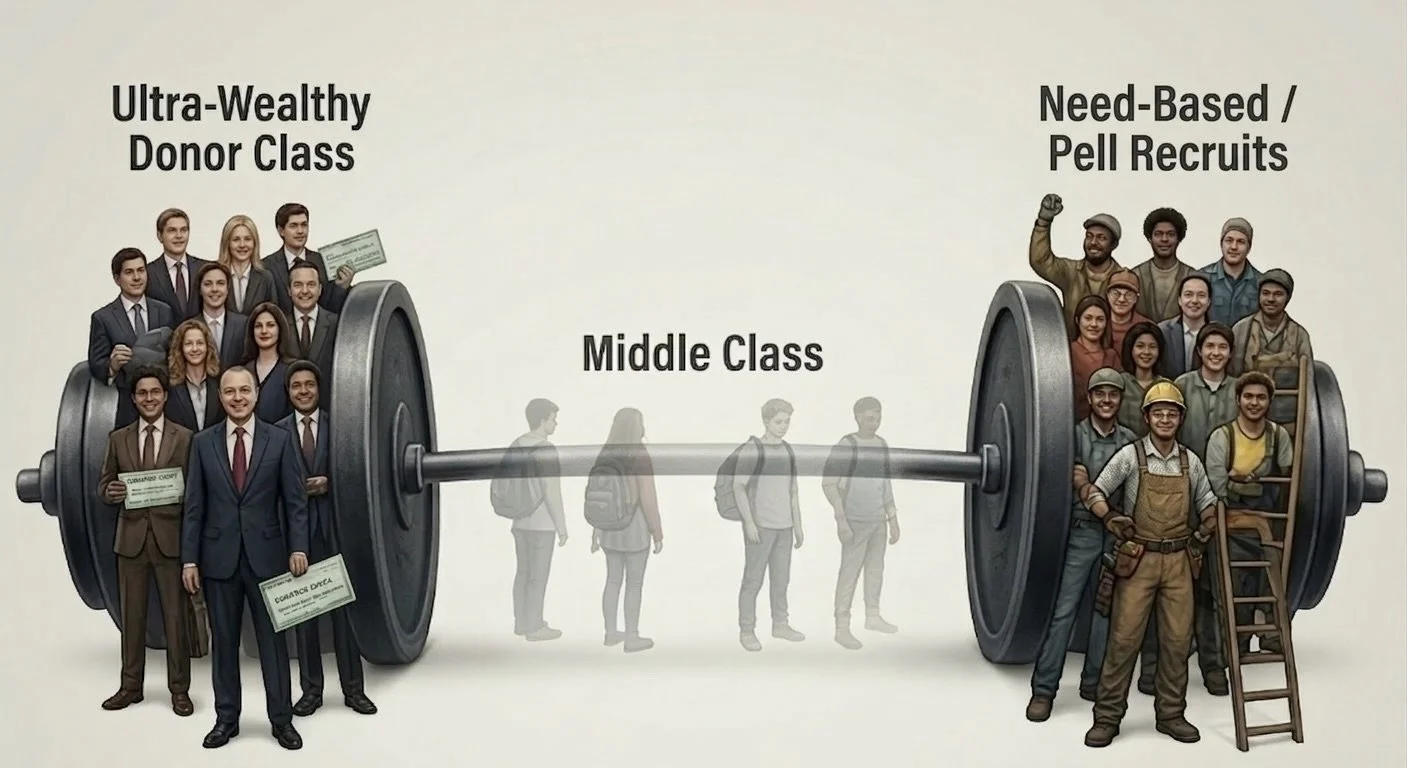
The "Barbell" Effect: A System of Extremes
The modern elite campus is increasingly divided into two distinct castes. On one end are the Ultra-Wealthy: the legacy admits, the children of major donors, and the hyper-coached athletes from elite private boarding schools. On the other end are the Pell-Eligible Recruits: low-income students whose "distance traveled" provides the diversity metrics and moral high ground schools crave.
Between these two pillars sits the Squeezed Middle—families earning between $150,000 and $250,000. These students are:
Too "Rich" for Aid: They don't qualify for the "Pell Surge" tips that now define "Economic Affirmative Action."
Too "Poor" to Influence: They lack the multi-million dollar building donation or the "connected" lineage that secures a spot for the bottom-tier academic performers of the 1%.
Too "Privileged" for the Narrative: Their stories of suburban stability and hard-earned "A" averages don't provide the "hardship" or "resiliency" hooks currently favored by essay readers.
A Catalyst to an Existing Trend
This isn't a new problem; it’s a chronic illness that has reached a crisis point. For years, the middle class has been overlooked in favor of the donor class and the athletic elite (who often dominate high-cost niche sports like crew or fencing).
Historically, race-based affirmative action was the primary tool used to offset these privileged groups. However, following the 2023 Supreme Court ruling, universities replaced racial metrics with Economic Diversity Tools. Instead of helping the middle class, this shift has only intensified their exclusion. To maintain a semblance of diversity, admissions officers are now hyper-focusing on the lowest economic quartiles, effectively "trading" middle-class seats for lower-income ones to balance the scales against the donor class.
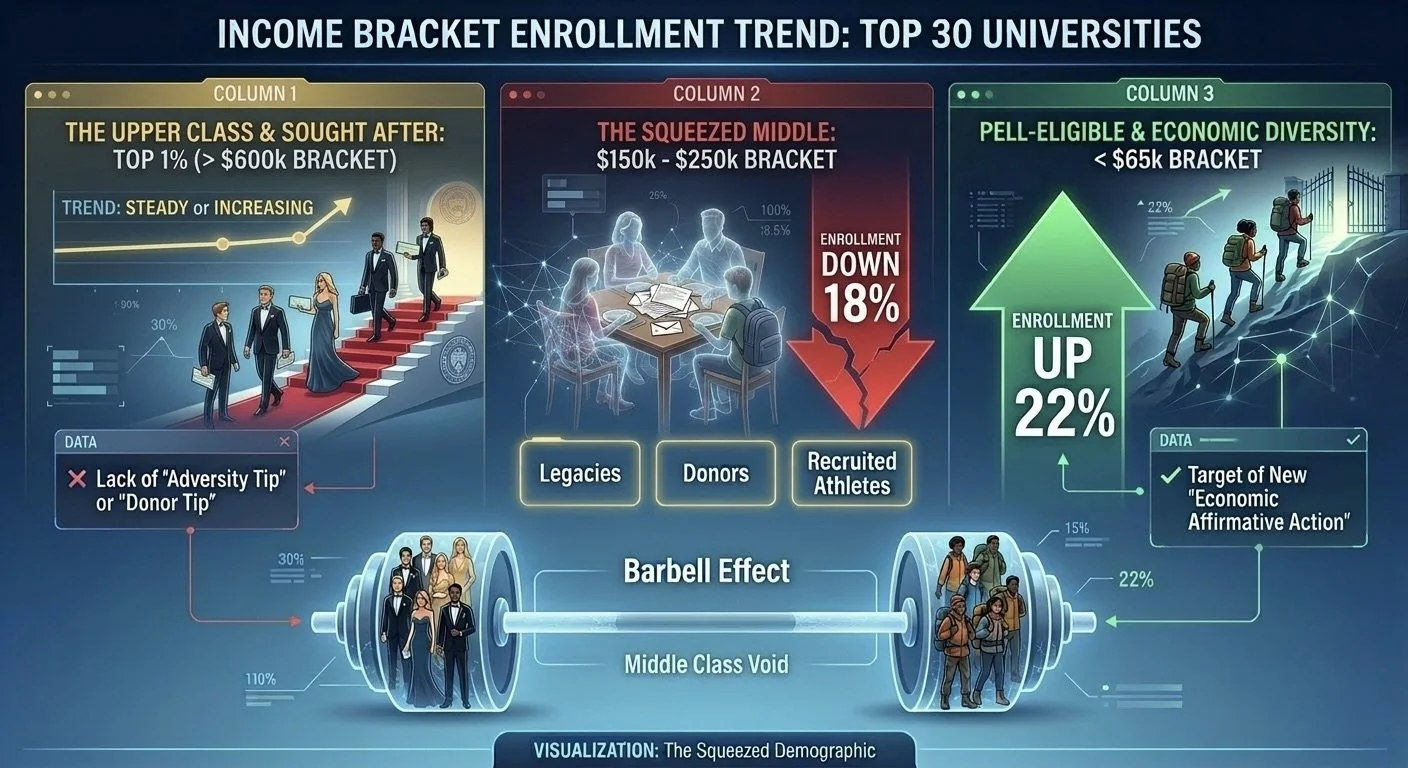
The Stats: A Disappearing Demographic
Recent findings from a recent Progressive Policy Institute (PPI) report of the 2025-2026 admissions cycle illustrates the thinning of the middle:
Income Bracket Enrollment Trend (Top 30 Unis)
The top 1% (>$600k) students remain steady or increasing
Legacies, Donors, Recruited AthletesMiddle class ($150k-$250k) student enrollment is down 18%
Lack of "Adversity Tip" or "Donor Tip"Pell-eligible (<$65k) students are up 22%.
Target of the new "Economic Affirmative Action"
For the child of two high-school principals or a mid-level software engineer, the math simply doesn't add up. They are competing for a shrinking slice of the pie against students who either have the resources to bypass the line or the hardships that grant them a "fast-pass."
The View from the Dean’s Desk
Behind the scenes, the deans and directors at top, private colleges’s admissions offices don’t (actually) speak of "fairness"; rather, they speak of "solvability." To an Ivy League Dean of Admissions, an admitted class is a high-stakes balance sheet where the middle class has become the dead weight.
This 'barbell' effect in admissions becomes basic math. In this cold calculus, the ultra-wealthy are the "investors" whose $95,000 checks and donations to the school’s endowment pay for operational costs and financial aid opportunities for need-based students who provide the university’s moral and social mission.

Four Strategies for Students in the Middle
Narrative is the New Perfect SAT Score: Your essay shouldn't just be about a "life-changing trip"; it needs to detail how your environment (economic, geographic, or social) shaped your perspective. If you are in the middle, you must find a unique hook that goes beyond your stability.
Seek Hardships, Challenges, and Failure: Admissions is a game of numbers defined by ratios. Whatever your school and community offers, do more. Students from middle-income families and school districts should go beyond what is offered to them to find unique challenges, risk failure, place themselves in the discomfort of hardships. Students need to show colleges they can go beyond the familiar and be resilient absent of resources.
The "Zip Code" Strategy: Schools are using tools like the College Board’s "Landscape" to see your school’s average income and AP availability. If you took every AP your "average" school offered, you are a star. If you took 5 APs at a school that offers 30, you're at a disadvantage.
Strategic Enrollment: Don't just aim for the Ivies. High-achieving students who would have previously been "diversity picks" are now "star recruits" at top-tier public universities (UCLA, Georgia Tech, Michigan), where they are often finding better merit-based aid and stronger support systems for middle-class families.
The lesson for the Class of 2027 is this: Do not let the stability of the middle define you. If colleges think your profile is the result of an assembly line of provided resources and opportunities, you have already been denied. You must prove you are the outlier, even in a world where everything was designed for you to be "normal." You much purposefully change your environment to change your results.